Showing posts with label gemstone jewelry. Show all posts

Sunday, May 16, 2010

Jewels Shine at Auction

source : nytimes.com
"Gems and jewels have been doing brilliantly at auction for months, as if bidders had never been told that there is a recession," Souren Melikian writes.A late 18th-century pair of ear clips with spinels and diamonds, cataloged as "the property of a German Princely and Liechtenstein Ruling Family," almost quadrupled the high estimate at $105,000 at Sotheby's Geneva auction.On Dec. 10, when the mood in London was at an all-time low, Christie's sold the most expensive jewel ever. The 35.56-carat blue diamond rose to $24.31 million, or to be strictly accurate, £16.39 million, to Laurence Graff of London.The gem's history goes back to the 17th century, when Philip IV of Spain gave it to his daughter Margaret Theresa on her betrothal to Leopold I, the ruler of the "Roman Germanic Empire." Later, it belonged to the Princes of Wittelsbach in Bavaria. The stone was cut by Sa'ida-ye Gilani, the Iranian poet, calligrapher and jeweler employed at the Moghul court by the emperor Jahangir (who reigned from 1605-1627), thus multiplying its potential value manyfold. However, the catalog did not mention this, since it was not known at the time of the sale.Five months later, another extraordinary price within its range was realized at Sotheby's in Geneva. A fancy blue diamond, a 7.03-carat gem, brought in $9.48 million, just over $1.34 million a carat, making the diamond the most expensive stone per carat ever sold in any category.Where aristocratic provenance could be established, jewels soared sky-high. A diadem and necklace made by Cartier in 1912 for Olga Princess Paley, Countess of Hohenfelsen, both doubled their high estimates. The diadem (described as an "aigrette tiara") set with rose-cut diamonds and two aquamarines, brought $512,014.The necklace, designed in the same heavily ornate style, cost an equally breathtaking $392,700.
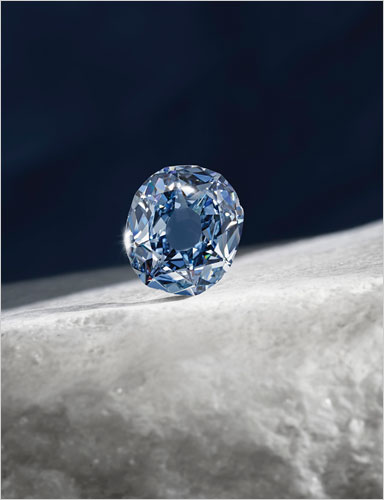
At Christie's late spring London sale of jewelry on June 10, signed jewels set with good quality stones sold like hot cakes regardless of style or period.

A necklace made from oval gold links joined by diamond-set clasps and signed Cartier Paris excited bidders, who sent it climbing to $42,750, more than triple the estimate.
Christie's "superb antique diamond brooch" was an unusual composite piece. Made up from magnificent 18th-century pear-shaped diamond drops hanging from an inverted lotus chalice, it exceeded the high estimate as a private collector from Britain footed the $374,824 bill.
In its own modest line, an Art Deco travel clock of spinach-green jade, its dial framed by a gold chain motif set off by black enamel, provided evidence of the private buyers' sunny disposition, as it brought $14,260, substantially more than the high estimate.

source : nytimes.com

Nice ice - Diamond jewelry still tops for retailers

source : nationaljewelernetwork.com
By Catherine Dayrit
May 04, 2010

Nice ice
Carla Amorim's "Champagne" ring in 18-karat yellow gold with 1.5 carats of diamonds; suggested retail price is $9,000. CarlaAmorim.com

New York--Despite widespread efforts to reduce inventory, there are some items that jewelers simply must keep in stock.

Diamond hoops and studs, as well as delicate pendants, are can't-go-wrong options for need-it-now customers, while trendy diamond charms and colored diamonds might catch the eye of customers seeking the unique.

Diamond jewelry continues to represent the largest category of sales among jewelry retailers, bar none, thanks in part to a marketing machine matched by no other jewelry category. Credit is also due to innovative new styles--who would have thought rough cuts and brown diamonds would become designer darlings?--offering a welcome retreat from the familiar. ...

Sotheby's blue diamonds set another color record

source : nationaljewelernetwork.com
May 12, 2010

Sotheby's blue diamonds set another color record

This 7.64-carat, cushion-shaped fancy intense blue diamond ring sold for $8.03 million, or $1.05 million per carat, Tuesday at Sotheby's in Geneva.

Geneva--Two blue diamonds broke records Tuesday in Geneva at Sotheby's "Spring Sales of Magnificent and Noble Jewels" in yet another display of the strength of natural colored diamonds at auctions worldwide.

In what Sotheby's terms the "standout moment of the day," a 7.64-carat, cushion-shaped fancy intense blue diamond mounted in a ring sold for $8.03 million, or $1.05 million per carat, following fierce competition from three buyers. According to a news release from Sotheby's, the sale sets a new record per-carat price for a fancy intense blue diamond sold at auction. ...

Sunday, May 9, 2010

Tanzanite celebration of life jewelry design awards 2006

tanzanite jewelrySabine Roemer
Sabine Roemer’s ring was inspired by the vivid blooms of a blue-violet wreath flower which, like tanzanite, is unique to the country of Tanzania. Sabine wanted to combine these two gifts of nature into a piece that is both organic and refined.
tanzanite jewelryRuth Grieco
Ruth Grieco has created a captivating, versatile piece which like many of her designs can adorn the body in different ways, here being both a brooch and a necklace. For Ruth, tanzanite’s changing blue-violet hues capture the mystery of maternity, and her piece is a magnificent celebration of tanzanite’s spectrum of colors. The detachable tanzanite drop lends movement, whilst the elongating effect of the diamond leaf forms give the piece a grace and fluidity, allowing it to fall perfectly whichever way it is worn.
tanzanite jewelryJames Powell

Delicate and richly detailed, James Powell’s design evokes the traditional motif of a stork delivering a baby.

But instead of a stork, James has created two exotic, ethereal hummingbirds that hover watchfully above their precious cargo. A stunning tanzanite drop represents newborn baby, and the cherished gift of new life.

tanzanite jewelry
Maria Canale for Suna Brothers

As with many of her designs, Maria Canale drew on nature’s inspirations for this pendant. The beauty of the changing seasons is captured in the opaque backdrop of a frozen lake, re-created through the innovative use of a circular optical lens. Graceful etchings depict fallen leaves trapped just beneath the water’s surface, whilst a dazzling tanzanite in deepest blue rises through the ice as a symbol of vitality and new life. When worn, the lake’s diamond circle is anchored to the necklace through a delicate chain of leaves, but the tanzanite appears to float, suspended gracefully against the skin.
tanzanite jewelryDima
Dima’s work is characterized by her instinctive blending of cultural styles and faith symbols. In these hoop earrings, crafted in Egyptian beaten gold, she intertwines the story of the Maasai’s traditional affinity with blue as the color of fertility with the biblical depiction of the snake in the Garden of Eden. As the snake coils sensually around the hoop, the tanzanite drops from its mouth, symbolizing the fruit of temptation.
tanzanite jewelryZoltan David
In Zoltan David’s winning necklace, flawless technical craftsmanship brings to life a richly detailed, timeless design. Zoltan’s “Flowerfly” captures the vitality of a flower in full bloom. The signature metal ornamentation technique that is Zoltan’s patented creation adds depth and texture to the wings and petals that flank a rare and spectacular matching pair of trilliant cut tanzanites.
tanzanite jewelryRodrigo Robson
Entitled “Start,” Rodrigo Robson’s necklace is a bold, contemporary exploration of the Be Born to Tanzaniteä theme. Highly innovative and original, Rodrigo’s design features real ultrasound film to portray in a modern, literal form the ever-inspiring miracle of new life. His circular links evoke the unbreakable bond between mother and child, whilst tanzanite, the precious gemstone of the present generation, perfectly completes this youthful celebration of birth.
tanzanite jewelryStephen Webster
Best known for his striking designs that bring out the fire in unique and exotic stones, Stephen Webster needed no greater inspiration than this 29 carat heart shaped tanzanite in deepest midnight blue with flashes of red. With Stephen’s signature edgy, contemporary touch, the traditional symbol of love becomes a show-stopping statement of passion. Highly stylized scrollwork set with diamonds give this classic cut a look that is spectacularly rock ‘n’ roll.
tanzanite jewelryGinny Dizon
In creating her cuff bracelet, Ginny Dizon drew her inspiration from the Maasai legend of tanzanite’s discovery, where a bolt of lightning set the land ablaze, transforming crystals on the ground into shimmering blue-violet gemstones. When the last cinders dissolved into the earth, awestruck Maasai tribesmen filled their pouches with the extraordinary gems, intuitively knowing that they would bring about a better life. Ginny’s cuff bracelet captures the drama of the lightning, whilst her use of both rough and facetted tanzanite symbolizes the journey each stone takes from its raw state in the earth to its final polished perfection. In Ginny’s interpretation, the theme “Be Born to Tanzaniteä” becomes a story of discovery, and a celebration of the natural miracle of this rare and elusive gem.
tanzanite jewelryColin Waylett
Colin Waylett’s stunning arm cuff is evocative of the noble traditions of Tanzania’s proud Maasai people. The interlocking shields represent the unity of warrior tribemen returning at sunset from a hunt against a blue and golden sky. The glinting of the last drops of sunlight catching the tips of the tribesmen’s spears is captured in the cuff’s diamond tips.
tanzanite jewelryLaurence Ratinaud
Laurence Ratinaud’s unique ring was inspired by the creation of life before birth. White gold is elegantly crafted into a mesh egg shape representing conception. It holds and protecting within it a simple tanzanite oval that signifies life itself. Laurence’s piece symbolizes both the simplicity and its fragility of the seed of new life, showing how something that becomes so infinitely complex can at its earliest moments be held in the palm of the hand.
tanzanite jewelryClaire Woolley
The universal and iconic image of the stork delivering a newborn is captured in Claire’s pendant. A beautiful tanzanite drop, representing the child, is delicately suspended from the necklace’s abstract depiction of the stork in this simple, graceful interpretation of the theme.
tanzanite jewelryTalento Joias
Talento Joias’ delicate, distinctive necklace combines twirling strands of tanzanite beads with polished tanzanite ovals set in starburst diamond clusters. Representing hope and life, its designers’, Rachel Tavora and Renata Bessa (featured above), were inspired by the Greek myth of the first woman, Pandora. Created under the direction of the god Zeus, Pandora was a poisoned gift to mankind. According to myth, Pandora was tempted by her curiosity to open the forbidden box given to her by Zeus. In doing so, she released all of mankind’s miseries locked inside, closing the box only in time to capture hope. Although paradise seemed lost, the myth ends with hope’s survival, showing that even in the bleakest of times, so long as hope survives, mankind keeps its chance to be re-born to a new and better life.
tanzanite jewelryMaria Webster for Boodles
Maria Webster’s graceful birth pendant for Boodles was inspired by the precious bond between mother and child. Fashioned in platinum and encrusted with diamonds, Maria’s pendant represents the cradling arm of a mother as she nurtures her baby.
tanzanite jewelryLouis Mariette
Louis Mariette’s spectacular design, fittingly entitled “A Dream in Africa,” was inspired by memories of his own childhood in Africa. Louis describes this as a dazzling assault on the senses, from the vibrant colors of exotic flowers in bloom to the jumble of semi-precious stones and crystals he would collect to create handmade bracelets and necklaces for his friends and neighbors. Louis’ tanzanite adorned headpiece is a vision of exuberant flowers, handmade in painted resin using a specially developed technique. Twirling metal work is encrusted with pink and lilac pearls, and on the largest cluster nestle sparkling tanzanite gemstones. Louis set the gemstones so that they would sit at the center of the wearer’s forehead, to signify the birthplace of all creativity, a person’s ideas, thoughts and dreams.
tanzanite jewelrySevan Bicakci
Sevan Bicakci’s extraordinary tanzanite ring was inspired by the traditional Tales of One Thousand and One Nights. In this tale, part of a frame story (stories within a story) the wives of the Sultan Schahriah live to see only one dawn after marriage because he has them beheaded the morning after their wedding night. However, his new wife, Princess Scheherazade, outruns her fate by telling the Sultan a new story each night, always stopping at the most exciting point so that he will let her live until the following evening. The ring re-creates the atmosphere in which Princess Scheherazade weaves her magic, enthralling her audience with her tales of mystery and adventure. In this way, the characters Aladdin, Ali Baba and Sinbad the Sailor were born, and in bringing them to life, the Princess earns her nightly reprieve, and survives to see another day.
tanzanite jewelry
Shaun Leane
Shaun Leane’s ring, innovative in design and breathtaking to behold, is set with a 10 carat tanzanite centerstone around which flows a coil of pavé set ocean blue sapphires. The tanzanite cleverly locks together with interchangeable bands designed to complement its magical and mysterious qualities. Shimmering natural black diamonds capture its intangible energy, whilst shimmering white diamonds intensify its refreshing brilliance. While the white diamond band is to wear by day, the black diamonds are perfect for evening.
tanzanite jewelryArabel Lebrusan
Arabel Lebrusan’s delightful, unusual earrings were inspired by the crochet work women in her native Spain use to create baby clothes and crib linen for newborns. The combinations of different thread structures with the resulting variety of forms and finishes are reflected in Arabel’s blending of white gold, silver and enamel to create the fans, swirls and teardrop forms in her feminine piece.
tanzanite jewelryStuart Weitzman and Le Vian
The Stuart Weitzman and Le Vian pair of evening shoes are true show-stoppers: a $2 million dollar creation in glistening silver leather embellished with over 185 carats of tanzanite and 28 carats of diamonds. Stunning ankle bracelets are set with museum quality tanzanite gemstones, painstakingly matched and cut by Le Vian’s master craftsmen, each crowned with a spectacular 16 carat, sparkling tanzanite drop which adorns the front of the foot. The shoes are balanced with a delicate diamond front strap that perfectly complements Stuart Weitzman’s timeless, elegant shoe design.
tanzanite jewelryKwiat
Janice DeBell’s tanzanite earrings for Kwiat were inspired by a desire to celebrate the gemstone’s unique spectrum of colors, from shimmering lilacs to deepest blue-violet. Juxtaposing trilliants and ovals, Janice has created a look that is powerful and full of drama, echoing the form of a traditional African tribal spear but with an aesthetic that is edgy and modern. But there is a final, unexpected touch of old-school glamour: turn over each spear and you will find a delicate dusting of diamond micro-pavé.
tanzanite jewelryCharlotte Ehinger-Schwarz 1876
Charlotte Ehinger-Schwarz’s extraordinary necklace is a tribute to the abundant geological landscape and the magnificent native wildlife of the country of Tanzania. A giraffe, elephant and ape nestle among precious rubies, tsavorite and zoisite. A detachable diamond drop carries the necklace’s centerpiece: a dramatic 25 carat marquis cut tanzanite.

source : tanzanitefoundation.com

The bridal category remains solid as a rock

source :nationaljewelernetwork
By Michelle Graff
Nisan 12, 2010

The bridal category remains solid as a rock
Natural blue and pink diamond ring by Scarselli Diamonds, Scarselli.com. Blue was the second hottest natural color diamond choice (behind yellow), with 22 percent of the vote, while 7 percent picked pink.


While consumers may remain hesitant to splurge on fashion jewelry, nothing seems to stop them from falling in love and getting married, the results of National Jeweler's Product Panel on bridal jewelry show.

Nearly half (47 percent) of the retail jewelers who took the survey reported that their loose diamond, diamond engagement ring and wedding band sales have increased over the last three years, while 36 percent said they have remained steady.

As the economy continues to bounce back, bridal will no doubt remain central to any jewelry store's success, as retailers find creative ways to adjust to a post-recession world and continued Internet interference. ...

Sunday, May 2, 2010

Historic stones rule the day at Christie's

source : nationaljewelernetwork.com
April 23, 2010

Historic stones rule the day at Christie'sLegend has it that the Archduke Maximilian, who once ruled as emperor of Mexico at the urging of Napoleon III, had the Emperor Maximilian Diamond in a pouch around his neck when he was executed by a firing squad. The 39.55-carat cushion-cut stone sold for $1.76 million at Christie's on Thursday.


New York--Two stones with colorful histories sold above their estimates Thursday at Christie's "Jewels: the New York Sale."

According to a news release issued by the auction house, a private U.S. buyer paid $1.76 million for the 39.55-carat, I color Emperor Maximilian Diamond, which was estimated to fetch between $1 million and $1.5 million.

The cushion-cut stone has a long and interesting history, having once been owned by the Archduke Maximilian, who ruled as emperor of Mexico at the insistence of Napoleon III but was later executed. It is believed that he was wearing the diamond around his neck when he faced the firing squad.

After passing through a number of owners, the stone fell into the hands of diamantaire Laurence Graff, who bought it at Christie's in 1982 and sold it to Imelda Marcos, widow of former Philippine President Ferdinand Marcos. ...

'Emeralds for Elephants' collection to hit London

source : nationaljewelernetwork.com
April 23, 2010


Designed by Sabine Roemer, the "Emerald Queen" featuring a 679-carat emerald will be one of 250 elephant statues that will be displayed in London this summer and will also be the highlight of a pop-up collection of bespoke emerald jewelry opening at Selfridge's in London next month.


London--Over the years, Chicago residents have strolled past life-sized "Cows on Parade" statues and Washington, D.C., denizens have corralled "Party Animals," an outdoor art exhibit of brightly decorated elephant and donkey statues. Now, Londoners will greet a vivid herd of elephant statues all their own, including one featuring a staggering 679-carat emerald.

In May, the "Emerald Queen," a life-size fiberglass elephant designed by U.K. jeweler Sabine Roemer, will debut in the Wonder Room of London-based department store Selfridge's. Decorated with Zambian emerald dust and featuring a hefty oval-shaped emerald as a headdress, the Emerald Queen will serve as the highlight of "Emeralds for Elephants," a pop-up collection of bespoke jewelry created by eight renowned designers.

The Emerald Queen is one of 250 elephant statues set to be displayed around London, from May through July 2010, as part of an effort to create public awareness about the plight of the endangered Asian elephant and to raise more than $3 million for the cause. ...

Topaz Jewelry Photos

Topaz GemstonesBlue Topaz RingBlue Topaz EarringsBlue Topaz NecklaceCaribbean Topaz

Friday, April 23, 2010

Black Diamonds

What are Black Diamonds, as seen in most jewelry?

Black diamonds are typically enhanced. Black diamonds are genuine diamonds treated with radiation to make their color appear black. Under normal lighting conditions the color enhanced black diamond looks black. However, it is actually very dark green. To observe the very dark green color, a fiber-optic light source can be placed near a thin edge of the diamond (such as the girdle or culet). This allows the light to illuminate some of the interior of the stone. The very dark green color that becomes visible is commonly seen in enhanced black diamonds. The very dark green color that is seen is never seen in natural diamonds. It is a result of radiation treatment.

Famous Black Diamonds

The Black Orloff

The Black Orloff black diamondThe Black Orloff (Orlov) cushion cut diamond (shown left) which still weighs in at a very respectable 67.50 carats. It is reported to have belonged to a nineteenth-century shrine near Pondicherry, India, and to have weighed 195 carats in the rough. Set in a diamond and platinum necklace, the Black Orloff has been widely exhibited. In 1969, the stone was sold for $300,000. It was resold in 1990 at Sothebys for $99,000. Also called the Eye of Brahma Diamond. The diamond is currently owned by Dennis Petimezas, a diamond dealer from Pennsylvania who bought the diamond for an unspecified sum in 2005.

"The Gruosi" Black Diamond

'The Gruosi' black diamond

Upon creating amazing black diamond jewelry for his luxury jewelry house de Grisogono, chairman and founder Fawaz Gruosi enjoys a special place in diamond history: he is credited with popularizing the fascination with black diamonds in 1996 - a fascination that continues today.

He also had a rare opportunity - a rare opportunity even for a grand jeweler like himself: he got to name a diamond. Naming a diamond is something reserved only for original buyers of a rough diamond. The de Grisogono founder chose the name "The Gruosi" for the incredible 115.34-carat black diamond. In fact, Fawaz Gruosi has actually been involved in naming two diamonds - the other being the 312.24-carat "The Spirit of Grisogono," also a black diamond with the famous Swiss jeweler Mr. de Grisogono. These two black diamonds are the two largest black diamonds in the world.

sources : generousgems.com,blackdiamonds.co.uk,vialuxe.com

Famous Emeralds

Gachala Emerald (origin: Colombia)
The Gachala Emerald is an uncut 5-cm emerald crystal weighing 858 carats (172 g). The stone was found in 1967 at Vega de San Juan mine in Colombia and is named after the mining district where it was discovered. Now in the United States, it was donated to the Smithsonian Institution by the New York jeweler, Harry Winston.

Gachala Emerald
Gachala Emerald
Chalk Emerald (origin: Colombia)
The Chalk Emerald is a 37.82 carats (7.56 g) Colombian emerald.

It originally weighed 38.40 carats (7.68 g), but was recut and set in a ring, where it is surrounded by sixty pear-shaped diamonds (totalling 15 carats (3.0 g), by Harry Winston Inc. The ring is housed in the National Gem and Mineral Collection at the Smithsonian Natural History Museum in the United States and was donated to the museum by Mr. and Mrs. O. Roy Chalk in 1972.
Chalk EmeraldChalk Emerald
Duke of Devonshire Emerald (origin: Colombia)

Duke of Devonshire EmeraldThe Duke of Devonshire Emerald gets its name from the 6th Duke of Devonshire, William Cavendish, who according to one version, received the enormous gemstone as a gift from the first emperor of Brazil, Don Pedro I, the son of King John VI of Portugal, but according to a second version purchased the gemstone from the emperor.

The Duke of Devonshire Emerald is a terminated hexagonal-shaped crystal discovered from the mines of Muzo, Santa Fe de Bogota, in Colombia, reputed to be the premier source of the world's finest emeralds. It is an exceptional deep-green emerald, with perfect transparency in certain areas, but heavily flawed in other areas. The emerald that measures 5 cm across the pinacoid also has a height of about 5 cm, and weighs 1,383.95 carats. The emerald had a reputation as the largest and finest uncut emerald in existence.

Duke of Devonshire EmeraldMackay Emerald
The stunning 167.97-carat Mackay Emerald was mined in Muzo, Columbia. The largest cut emerald in the National Gem Collection, it is set in an Art Deco diamond and platinum necklace designed by Cartier Inc. In 1931, Clarence H. Mackay presented the necklace as a wedding gift to his wife, Anna Case, a prima donna of the New York Metropolitan Opera from 1909 to 1920. The piece was donated to the Smithsonian Institute by Mrs. Anna Case Mackay in 1984. Source: The National Gem Collection by Jeffrey E. Post.
Mackay Emerald