 "Gems and jewels have been doing brilliantly at auction for months, as if bidders had never been told that there is a recession," Souren Melikian writes.A late 18th-century pair of ear clips with spinels and diamonds, cataloged as "the property of a German Princely and Liechtenstein Ruling Family," almost quadrupled the high estimate at $105,000 at Sotheby's Geneva auction.
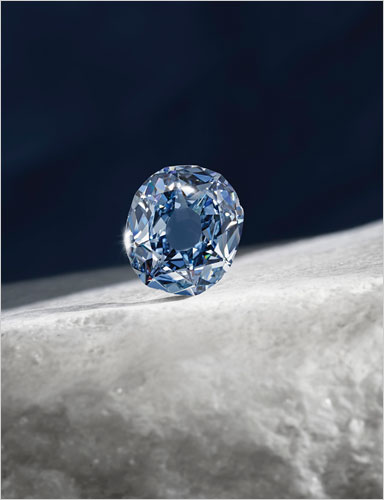 On Dec. 10, when the mood in London was at an all-time low, Christie's sold the most expensive jewel ever. The 35.56-carat blue diamond rose to $24.31 million, or to be strictly accurate, £16.39 million, to Laurence Graff of London.The gem's history goes back to the 17th century, when Philip IV of Spain gave it to his daughter Margaret Theresa on her betrothal to Leopold I, the ruler of the "Roman Germanic Empire." Later, it belonged to the Princes of Wittelsbach in Bavaria. The stone was cut by Sa'ida-ye Gilani, the Iranian poet, calligrapher and jeweler employed at the Moghul court by the emperor Jahangir (who reigned from 1605-1627), thus multiplying its potential value manyfold. However, the catalog did not mention this, since it was not known at the time of the sale.
 Five months later, another extraordinary price within its range was realized at Sotheby's in Geneva. A fancy blue diamond, a 7.03-carat gem, brought in $9.48 million, just over $1.34 million a carat, making the diamond the most expensive stone per carat ever sold in any category.
 Where aristocratic provenance could be established, jewels soared sky-high. A diadem and necklace made by Cartier in 1912 for Olga Princess Paley, Countess of Hohenfelsen, both doubled their high estimates. The diadem (described as an "aigrette tiara") set with rose-cut diamonds and two aquamarines, brought $512,014.
 The necklace, designed in the same heavily ornate style, cost an equally breathtaking $392,700.
 At Christie's late spring London sale of jewelry on June 10, signed jewels set with good quality stones sold like hot cakes regardless of style or period.
A necklace made from oval gold links joined by diamond-set clasps and signed Cartier Paris excited bidders, who sent it climbing to $42,750, more than triple the estimate.
 Christie's "superb antique diamond brooch" was an unusual composite piece. Made up from magnificent 18th-century pear-shaped diamond drops hanging from an inverted lotus chalice, it exceeded the high estimate as a private collector from Britain footed the $374,824 bill.
 In its own modest line, an Art Deco travel clock of spinach-green jade, its dial framed by a gold chain motif set off by black enamel, provided evidence of the private buyers' sunny disposition, as it brought $14,260, substantially more than the high estimate.
 source : nytimes.com

