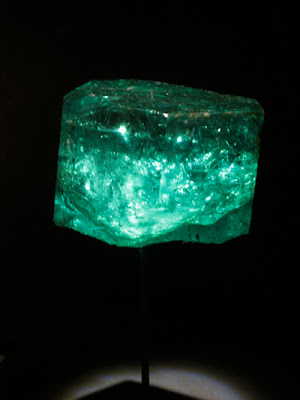
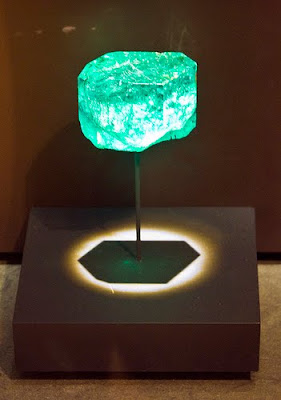
Gachala Emerald (origin: Colombia)The Gachala Emerald is an uncut 5-cm
emerald crystal weighing 858 carats (172 g). The stone was found in 1967 at Vega de San Juan mine in Colombia and is named after the mining district where it was discovered. Now in the United States, it was donated to the
Smithsonian Institution by the New York jeweler, Harry Winston.
 Chalk Emerald (origin: Colombia)
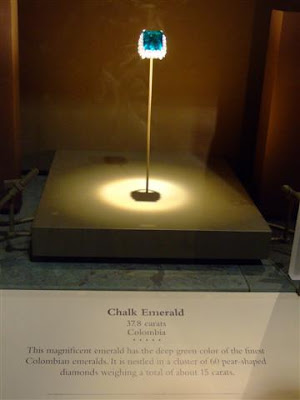
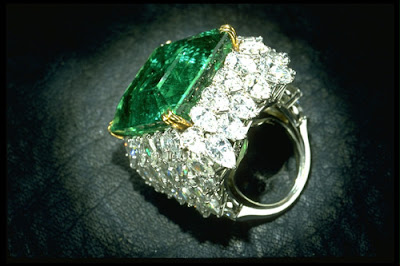
The Chalk Emerald is a 37.82 carats (7.56 g) Colombian emerald.
It originally weighed 38.40 carats (7.68 g), but was recut and set in a ring, where it is surrounded by sixty pear-shaped
diamonds (totalling 15 carats (3.0 g), by Harry Winston Inc. The ring is housed in the National
Gem and
Mineral Collection at the Smithsonian Natural History Museum in the United States and was donated to the museum by Mr. and Mrs. O. Roy Chalk in 1972.
 Duke of Devonshire Emerald (origin: Colombia)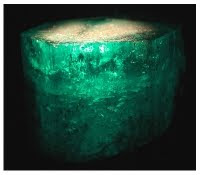
The Duke of Devonshire Emerald gets its name from the 6th Duke of Devonshire, William Cavendish, who according to one version, received the enormous gemstone as a gift from the first emperor of Brazil, Don Pedro I, the son of King John VI of Portugal, but according to a second version purchased the
gemstone from the emperor.
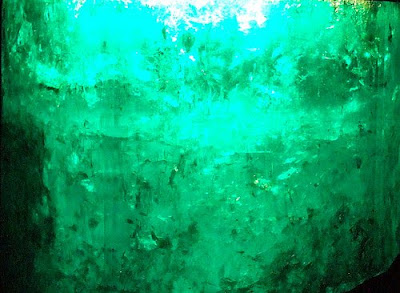
The Duke of Devonshire Emerald is a terminated hexagonal-shaped crystal discovered from the mines of Muzo, Santa Fe de Bogota, in Colombia, reputed to be the premier source of the world's finest emeralds. It is an exceptional deep-green emerald, with perfect transparency in certain areas, but heavily flawed in other areas. The emerald that measures 5 cm across the pinacoid also has a height of about 5 cm, and weighs 1,383.95 carats. The emerald had a reputation as the largest and finest uncut emerald in existence.
 Mackay Emerald
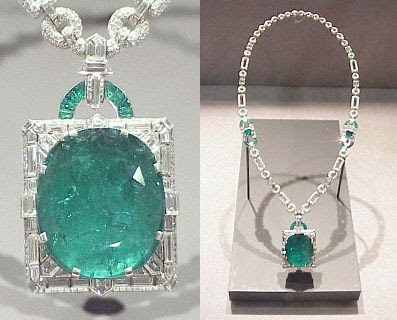
The stunning 167.97-carat Mackay Emerald was mined in Muzo, Columbia. The largest cut
emerald in the National Gem Collection, it is set in an Art Deco diamond and platinum necklace designed by Cartier Inc. In 1931, Clarence H. Mackay presented the necklace as a wedding gift to his wife, Anna Case, a prima donna of the New York Metropolitan Opera from 1909 to 1920. The piece was donated to the Smithsonian Institute by Mrs. Anna Case Mackay in 1984. Source:
The National Gem Collection by Jeffrey E. Post.
 Due to the fact that the marriage does not happen often in life, most couples tend to pour their savings into making your wedding dreams come true. In fact, the fact that weddings are not cheap. Preparations and only cost a fortune. Then the wedding rings. Despite the fact that wedding bands are not merely symbols of the union, still can not deny the fact that these rings are still regarded as gems and jewelry is not cheap. According to the preparation side, some couples also end up buying expensive wedding rings or wedding ring sets, which in turn has strained its budget.


